Ovarian Cyst - Dermoid Cist Illustration Picture Symptoms Pain Cures Sist
Posted On Wed Jan 31, 2007 By marggie In Blogs About Many Topics That Are Interesting For Discussion In Forums Forums
today i went to the doctor and he told me i had An ovarian cyst (dermoid cist) on my right hand side of my pelvis near below my stomach, so what is a cyst i asked her, she said a cyst is a fluid-filled sac (follicle) that contains a maturing egg; it forms on the ovary's surface, then disappears not long after it releases the egg. If a mature egg is not released or if the sac reseals after releasing the egg, the sac can swell up with fluid, forming a functional ovarian cyst.
Most functional ovarian cysts do not cause symptoms and go away by themselves. However, they do sometimes rupture, twist, or bleed, which can cause severe pelvic pain.
i dont have all the information on this page, if you suspect you may have a cist, you should see your doctor. this page is just for your information only.
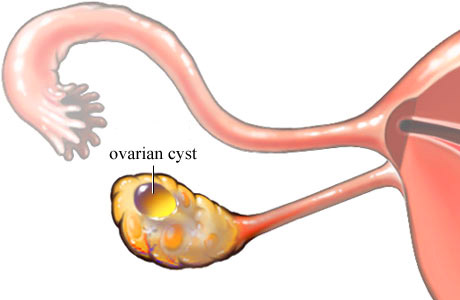
An ovarian cyst is a round, thin-walled, clear fluid-filled sac that develops in the ovary as part of normal egg development. When on the ovary's surface, an ovarian cyst looks something like a skin blister. A normal ovarian cyst can grow as large as 1.5 in. (3.8 cm) as it prepares to release an egg into the abdomen (ovulation).
When an ovarian cyst does not release its egg, it continues to grow, becoming larger than normal (functional ovarian cyst). A functional ovarian cyst may also form after an egg is released. In this case, the ovarian cyst reseals itself and swells with fluid. This is called a luteal cyst. Functional ovarian cysts are the most common type of ovarian growth in women of childbearing age.1
Like most types of ovarian cysts, functional cysts usually don't cause symptoms and are first noticed during a general pelvic exam. However, a larger ovarian cyst can twist, rupture, or bleed and be very painful. If your health professional has found that you have a functional ovarian cyst, you have no reason to worry about cancer—functional cysts do not lead to cancer. Most functional ovarian cysts go away on their own within a few months and are harmless.
What causes functional ovarian cysts?
A functional ovarian cyst is caused by one or more slight changes in the way the ovary produces or releases an egg.
If you are postmenopausal, you are not ovulating and cannot develop a functional ovarian cyst. However, it is possible to have one that you developed when you were still ovulating.
Although unlikely, it is possible to ovulate while taking hormonal birth control pills and, therefore, to be capable of developing a functional ovarian cyst.
What are the symptoms?
Most functional ovarian cysts are harmless, do not cause symptoms, and go away without treatment. However, they can cause symptoms such as:
* Lower abdominal pain or ache, typically in the middle of your menstrual cycle.
* Menstrual period delay.
* Weight gain.
* Unexpected vaginal bleeding.
Some functional ovarian cysts can twist or rupture and bleed. Symptoms include:
* Sudden severe pain, often with nausea and vomiting (possible sign of a twisted cyst).
* Pain immediately after intercourse (possible sign of a ruptured cyst).
If you have symptoms that suggest a twisted or ruptured ovarian cyst, call your health professional immediately. Some ruptured cysts bleed enough that treatment is necessary to prevent heavy blood loss.
How are functional ovarian cysts diagnosed?
If your health professional discovers an ovarian cyst during a routine pelvic exam, he or she may use a pelvic ultrasound to make sure the cyst is fluid-filled (functional), then recommend a watchful waiting period and recheck you after a couple of menstrual cycles. A functional ovarian cyst is likely to go away on its own during this period of time.
If you see your health professional for pelvic pain or bleeding, you'll be evaluated for a number of conditions that may be causing your symptoms. Your evaluation will include a pelvic exam, a history of your symptoms and menstrual periods, a family history, and possibly a pelvic ultrasound. An ultrasound can show the difference between a fluid-filled functional cyst and any solid growth, which can be further evaluated using a tiny viewing instrument inserted through a small incision (laparoscopy).
How are they treated?
Most functional ovarian cysts go away without treatment within 1 to 3 menstrual cycles. If you have a functional cyst that persists through 2 to 3 menstrual cycles or that causes symptoms, your health professional will probably recommend birth control pills, which stop the ovulation process. Birth control pills should prevent new functional cysts from developing, but they may not speed up the shrinkage of an existing cyst.
If a cyst does not go away, your health professional may want to surgically remove the cyst.
If you have a cyst that bleeds or causes severe pain, you can have it surgically removed.
Most functional ovarian cysts do not cause symptoms and go away by themselves. However, they do sometimes rupture, twist, or bleed, which can cause severe pelvic pain.
i dont have all the information on this page, if you suspect you may have a cist, you should see your doctor. this page is just for your information only.

An ovarian cyst is a round, thin-walled, clear fluid-filled sac that develops in the ovary as part of normal egg development. When on the ovary's surface, an ovarian cyst looks something like a skin blister. A normal ovarian cyst can grow as large as 1.5 in. (3.8 cm) as it prepares to release an egg into the abdomen (ovulation).
When an ovarian cyst does not release its egg, it continues to grow, becoming larger than normal (functional ovarian cyst). A functional ovarian cyst may also form after an egg is released. In this case, the ovarian cyst reseals itself and swells with fluid. This is called a luteal cyst. Functional ovarian cysts are the most common type of ovarian growth in women of childbearing age.1
Like most types of ovarian cysts, functional cysts usually don't cause symptoms and are first noticed during a general pelvic exam. However, a larger ovarian cyst can twist, rupture, or bleed and be very painful. If your health professional has found that you have a functional ovarian cyst, you have no reason to worry about cancer—functional cysts do not lead to cancer. Most functional ovarian cysts go away on their own within a few months and are harmless.
What causes functional ovarian cysts?
A functional ovarian cyst is caused by one or more slight changes in the way the ovary produces or releases an egg.
If you are postmenopausal, you are not ovulating and cannot develop a functional ovarian cyst. However, it is possible to have one that you developed when you were still ovulating.
Although unlikely, it is possible to ovulate while taking hormonal birth control pills and, therefore, to be capable of developing a functional ovarian cyst.
What are the symptoms?
Most functional ovarian cysts are harmless, do not cause symptoms, and go away without treatment. However, they can cause symptoms such as:
* Lower abdominal pain or ache, typically in the middle of your menstrual cycle.
* Menstrual period delay.
* Weight gain.
* Unexpected vaginal bleeding.
Some functional ovarian cysts can twist or rupture and bleed. Symptoms include:
* Sudden severe pain, often with nausea and vomiting (possible sign of a twisted cyst).
* Pain immediately after intercourse (possible sign of a ruptured cyst).
If you have symptoms that suggest a twisted or ruptured ovarian cyst, call your health professional immediately. Some ruptured cysts bleed enough that treatment is necessary to prevent heavy blood loss.
How are functional ovarian cysts diagnosed?
If your health professional discovers an ovarian cyst during a routine pelvic exam, he or she may use a pelvic ultrasound to make sure the cyst is fluid-filled (functional), then recommend a watchful waiting period and recheck you after a couple of menstrual cycles. A functional ovarian cyst is likely to go away on its own during this period of time.
If you see your health professional for pelvic pain or bleeding, you'll be evaluated for a number of conditions that may be causing your symptoms. Your evaluation will include a pelvic exam, a history of your symptoms and menstrual periods, a family history, and possibly a pelvic ultrasound. An ultrasound can show the difference between a fluid-filled functional cyst and any solid growth, which can be further evaluated using a tiny viewing instrument inserted through a small incision (laparoscopy).
How are they treated?
Most functional ovarian cysts go away without treatment within 1 to 3 menstrual cycles. If you have a functional cyst that persists through 2 to 3 menstrual cycles or that causes symptoms, your health professional will probably recommend birth control pills, which stop the ovulation process. Birth control pills should prevent new functional cysts from developing, but they may not speed up the shrinkage of an existing cyst.
If a cyst does not go away, your health professional may want to surgically remove the cyst.
If you have a cyst that bleeds or causes severe pain, you can have it surgically removed.
Dimples Sun May 27, 2012
can you have a 3cm cysts and still get pregnant.
Christina Tue Mar 20, 2012
I am 32 I just had to have surgery early this morning at 4am due to pain in my right side of my abdomen I had went to ER in they did 3 test on me showed my ovarie had a ruptured cyst they had to fix
amy Sun Mar 11, 2012
I had a dermiod cyst removed last year and it was the best thing i'd ever done. I had the cyst for well over a year when i finally couldn't take the pain anymore. I got the worst of my pain after my periods and the pain would last around 4-5 days before it got better. My doctor put me on endone for the pain but it didn't help at all. I went to hospital because i was throwing up because of the pain. They put me on morphine for over eight hours and the doctors were shocked when my pain didn't go away even after all the morphine. The only reason i got better was because it was my towards the end of my 4-5 days after my cycle. I had keyhole surgery and that was nothing compared to the pain of my cyst..i strongly recommend just getting it taken out..
monica Sun Nov 27, 2011
HEY i just seen your comment, buy some molasse and raw beets, take a food extractor and when you get the juice out of the beets mix it with the molasse put it in the refrigerator and drink this 3 times a day first one take it when you first wake up, and than the other 2 after foods this will take it away in 2 months no needs of surgery,by the way molasse is sugar cane honey.
Myrna Sat Nov 12, 2011
My name is Myrna and i just went to the doctor for my result of a pap and ultrasound . I'm 48 years old. Well they found 3 cysts 2 on the right of my ovary and 1 on my left ovary and also a kidney stone and enlarge uterus wow lots of stuff, So now i have to go back when i get my period so they can check my uterus again period and also do another pap to check cysts again. I'm really scared of getting a hysterectomy not scared terrified.
Felicia Sun Sep 18, 2011
Hi my name is Felicia.im 17years old and i have a 11 month old son...... I woke up on Friday morning with a slight pain in my stomach,i thought i had gas or air pocket in my stomach I didn't pay much attention to it. Till hours later me and my family went to town and in the car I started to get these severe sharp pain. I started vomiting and I still thought maybe its gas,then the pain felt like i had a uti again. But i was still putting up with the agonizing pain cause i dont like hospitals cause they take long and all the doctors do is watch you be in pain and gossip about others like if they dont have a job to do. So finally when i couldn't put up with the pain any more my mom took me to the ER. They called me sat there in the chair in pain while they ask questions for 15 minutes straight. Then they took me to the room and the doctor just asked how does the pain feel and i told him like if i have a uti. Then he just said ok and left. A nurse came to take a urine sample. 4 agonizing hours later they finally gave me pain medicine not cause they wanted to but because i came out my room and told them if they can give me anything for my pain. After that they wanted to do this cat scan to make sure i dont have any gawstones and that took 3 hours cause i had to drink 2 liters of some sweet syrupy drink they take me to the room to do the scan. They took me back to my room and did more test.2 Hours later they finally tell me i have ovarian cyst on my left. And that its 3 inches close to 4 in.and they realesed me with pain meds and something else so i won't throw up any more then told me that i have to contact my obgyn to see what's goin to happen. So now I'm very emotionally scared and have to wait And call the doctor to see what's goin to happen. Does anyone know what i can do to get rid of it naturally without surgery being done :'( i never had surgery in my life :'(:'(:'(
Julie Sat Jun 18, 2011
I went to the doctors on Thursday for pelvic pain and pain during intercourse, on top of that we don't know if the bleeding I've been having is from the depo shot or from something else. she did the pelvic exam and an ultrasound. she didn't find anything so she thinks that a had a cyst on my left ovary and that it burst....she told me to just change positions and take ibuprofen before intercourse. does anyone else have pain during (not after) intercourse?
linda Sun Oct 17, 2010
my daugher is 11. She has sist on both of her ovareis and fluid. She hasnt started her cycle and is has alote of pain. what should i do?
Neia Mon Aug 30, 2010
I had lots of pain shoot on my lower left and it would not stop. It just happend out of no where, I got rushed to the hospital where they keep suggesting I may be pregnat in my tubes. Well they toke tests and blood and told me i have a 9.5 cm cyst and like Chelsa they sent me home with percocets and told me it may twist or rupture .. wow .. I have to set up my own surgry and its looking like I am getting no where.
Chelsea Thu Aug 19, 2010
I went to the ER on Sunday because I had severe abdominal pain. I thought I maybe had Appendicitis. It came back that I've got a 4.8 cm cyst on my left ovary and a 6.3 cm cyst on my right ovary.
They gave me Vicodin and sent me home. They were really afraid that they might flip and strangle my ovary.
Does that mean I shouldn't do any physical activity? When will they go away?
I've gained 7 lbs and I am just sick of having them now.
I got my period today, but it only added cramps along with the pain of the cysts.
Thanks so much!
They gave me Vicodin and sent me home. They were really afraid that they might flip and strangle my ovary.
Does that mean I shouldn't do any physical activity? When will they go away?
I've gained 7 lbs and I am just sick of having them now.
I got my period today, but it only added cramps along with the pain of the cysts.
Thanks so much!
Bhawna Sun Jun 27, 2010
How much time will it take to get it normal conditions. We have consulted with doctor.
mandy Tue May 25, 2010
thanks so much this was very informative what i don't want to take birth control for it and it doesn't go away will the doctor do surgery ?
mira Mon Mar 08, 2010
2 weeks after gaving birth i had terrible pain in my stomach and my pelvis, i went to ER and they found out that i had a dermoid cyst that is twisted that makes the pain so super painful is more painful that having a labor, i had a surgery right away coz there worried it might burst. but it was a benign cytst.
mercy Sat Feb 13, 2010
i had an ovarian cyst removed in February 2004 from my left ovary then last year august i was diagnosis another ovarian cyst again in the same left ovary what do
i do i don't want to go through another surgery
Kathrine Wed Jan 27, 2010
I find this sum good information. When I was pregnant the doctor thought that I had an overian cysts and now since I gave birth to my 1st daughter never had a period but only thing I had was a day of spotting and that was it. so the 2day thought that I may have an overian cysts...but I don't know if i have it for sure yet..
Related Content
Information
Forums »
Blogs About Many Topics That Are Interesting For Discussion In Forums »
Ovarian Cyst - Dermoid Cist Illustration Picture Symptoms Pain Cures Sist
Blogs About Many Topics That Are Interesting For Discussion In Forums »
Ovarian Cyst - Dermoid Cist Illustration Picture Symptoms Pain Cures Sist
Title: Ovarian Cyst - Dermoid Cist Illustration Picture Symptoms Pain Cures Sist
Description: Ovarian Cyst - Dermoid Cist Illustration Picture Symptoms Pain Cures Sist
Tags: ovarian ,cyst ,dermoid ,cist ,illustration ,picture ,symptoms ,pain ,cures ,sist
Info: This Post Has Been Viewed 0 Times Since
Date: Wed Jan 31, 2007
Author marggie Received 51 Replies #1655
Date: Wed Jan 31, 2007
Author marggie Received 51 Replies #1655
Share
URL: 

Embed: 

To embed this topic, just copy the code from the "Embed" box. Once you've copied the code, just paste it into your website or blog to embed it
BBCODE:: 

BBCODE is use on forums. You can put this code on all your BBCODE enabled forums like PhpBB, vBulletin® and others. Just Copy and Paste this code on your Posts and Replies on your forums
wallpaperama | Wallpapers | Forums | Terms Of Service
copyright © 2013 wallpaperama - All Rights Reserved - Last Updated Mon May 06, 2013 (-8 GMT)
Powered by: Webune Forums V5
copyright © 2013 wallpaperama - All Rights Reserved - Last Updated Mon May 06, 2013 (-8 GMT)
Powered by: Webune Forums V5