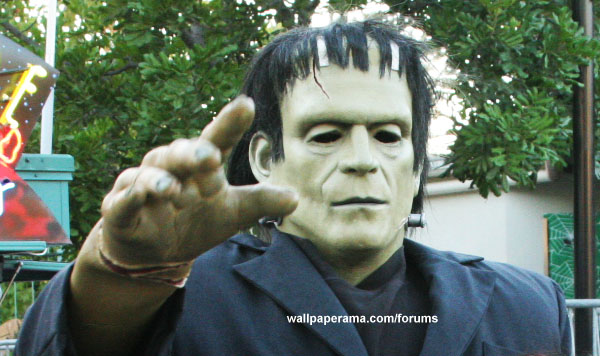
BOOOOOO!
I have some halloween wallpapers in the works, i will post them as soon as i can before Oct. 31 on haloween day.
The History/Story of Halloween
Halloween is an observance celebrated on the night of October 31, most notably by children dressing in costumes and going door-to-door collecting sweets. It is celebrated in much of the Western world, though most common in the United States, Puerto Rico, Ireland, the United Kingdom, Canada, and with increasing popularity in Australia and New Zealand. Halloween originated in Ireland as the pagan Celtic harvest festival, Samhain. Irish, Scots and other immigrants brought older versions of the tradition to North America in the 19th century. Most other Western countries have embraced Halloween as a part of American pop culture in the late 20th century.
The term Halloween, and its older spelling Hallowe'en, is shortened from All-hallow-even, as it is the evening before "All Hallows' Day" also known as "All Saints' Day". In Ireland, the name was All Hallows' Eve often shortened to Hallow Eve, and though seldomly used today, it is still a well accepted label. Halloween was also sometimes called All Saints' Eve. The holiday was a day of religious festivities in various northern European pagan traditions, until it was appropriated by Christian missionaries and given a Christian interpretation. Halloween is also called Pooky Night in some parts of Ireland, presumably named after the púca, a mischievous spirit. In Australia it is sometimes referred to as "mischief night", by locals.
Halloween is sometimes associated with the occult. Many European cultural traditions hold that Halloween is one of the liminal times of the year when the spiritual world can make contact with the physical world and when magic is most potent e.g. Catalan mythology about witches.
Halloween did not become a holiday in America until the 19th century, where lingering Puritan tradition meant even Christmas was scarcely observed before the 1800s. North American almanacs of the late 18th and early 19th centuries make no mention of Halloween in their lists of holidays. The transatlantic migration of nearly two million Irish following the Irish Potato Famine 1845–1849 brought the holiday and its customs to America. Scottish emigration from the British Isles, primarily to Canada before 1870 and to the United States thereafter, brought that country's own version of the holiday to North America.
When the holiday was observed in 19th-century America, it was generally in three ways. Scottish-American and Irish-American societies held dinners and balls that celebrated their heritages, with perhaps a recitation of Robert Burns' poem "Hallowe'en" or a telling of Irish legends, much as Columbus Day celebrations were more about Italian-American heritage than Columbus. Home parties would center around children's activities, such as bobbing for apples and various divination games, particularly about future romance. And finally, pranks and mischief were common on Halloween.
Commercial exploitation of Halloween in America did not begin until the 20th century. The earliest were perhaps Halloween postcards, which were most popular between 1905 and 1915, and featured hundreds of different designs. Dennison Manufacturing Company, which published its first Halloween catalog in 1909, and the Beistle Company were pioneers in commercially made Halloween decorations, particularly die-cut paper items. German manufacturers specialized in Halloween figurines that were exported to America in the period between the two world wars.
There is little primary documentation of masking or costuming on Halloween in America, or elsewhere, before 1900. Mass-produced Halloween costumes did not appear in stores until the 1950s, when trick-or-treating became a fixture of the holiday, although commercially made masks were available earlier.
In the United States, Halloween has become one of the most profitable holidays, next to Christmas, for retailers. In the 1990s many manufactures began producing a larger variety of Halloween yard decorations; prior to this a majority of decorations were homemade. Some of the most popular yard decorations are jack-o'-lanterns, scarecrows, witches, orange and purple string lights, inflatable decorations such as spiders, pumpkins, mummies, Draculas and Frankensteins, and animatronic window and door decorations. Other popular decoration are foam tombstones and gargoyles.
The National Confectioners Association reported in 2005 that 80 percent of adults planned to give out candy to trick-or-treaters, and that 93 percent of children planned to go trick-or-treating..
Anoka, Minnesota, USA, the self-proclaimed "Halloween Capital of the World," celebrates with a large civic parade. Salem, Massachusetts, also has laid claim to the title, though Salem has tried to separate itself from its history of prosecuting witchcraft. Despite that, the city does see a great deal of tourism surrounding the Salem witch trials, especially around Halloween.
New York City hosts the United States' largest Halloween celebration, The Village Halloween Parade. Started by a Greenwich Village mask maker in 1973, the parade now attracts over two million spectators and participants as well as roughly four million television viewers each year. It is the largest participatory parade in the country if not the world, encouraging spectators to march in the parade as well. It is also the largest annual parade held at night.
In many towns and cities, trick-or-treaters are welcomed by lighted porch lights. In some large or crime-ridden cities, however, trick-or-treating is discouraged, forbidden, or restricted to staged trick-or-treating events within one or more of the cities' shopping malls, in order to prevent potential acts of violence against trick-or-treaters.
Those living in the country may hold Halloween parties. These parties usually involve games often traditional games like bobbing for apples, searching for candy in a similar manner to Easter egg hunting, or a snipe hunt, a hayrack ride often accompanied by a scary story and one or more masked and costumed people hiding in the dark to jump out and scare the riders, and treats usually a bag of candy and/or homemade treats. Scary movies may also be watched. Normally, the children are picked up by their parents at pre-determined times. However, it is not uncommon for these parties to include sleepovers.
In many places, October 30 is known as Devil's Night or Mischief Night and is a night in which people, usually teenagers, commit acts of vandalism or arson. Such acts can include covering houses in toilet paper or smashing raw eggs on people's cars.
The War of the Worlds, a radio adaptation by Orson Welles based upon H. G. Wells' classic novel of the same name, was performed by Mercury Theatre on the Air as a Halloween special on October 30, 1938 and the live broadcast reportedly frightened many listeners into believing that an actual Martian invasion was in progress.
The main event of modern US-style Halloween is trick-or-treating, in which children dress up in costume disguises and go door-to-door in their neighborhood, ringing each doorbell and yelling "trick or treat!" Although this resembles the older tradition of guising in Ireland and Scotland, ritual begging on Halloween does not appear in English-speaking America until the 20th century, and may have developed independently. The occupants of the house who might themselves dress in a scary costume will then hand out small candies, miniature chocolate bars, and sometimes even soda pop. Some American homes will use sound effects and fog machines to help set a spooky mood. Other house decoration themes that are less scary are used to entertain younger visitors. Children can often accumulate many treats on Halloween night, filling up entire pillow cases or shopping bags.
In Ireland, great bonfires were lit throughout the breadth of the land. Young children in their guises were gladly received by the neighbors with some "fruit, apples and nuts and of course sweets" for the "Halloween Party", whilst older male siblings played innocent pranks on bewildered victims.
In Scotland, children or guisers are more likely to recite "The sky is blue, the grass is green, may we have our Halloween" instead of "trick or treat!". They visit neighbours in groups and must impress the members of the houses they visit with a song, poem, trick, joke or dance in order to earn their treats. Traditionally, nuts, oranges, apples and dried fruit were offered, though sometimes children would also earn a small amount of cash, usually a sixpence. Very small children often take part, for whom the experience of performing can be more terrifying than the ghosts outside.
Tricks play less of a role in modern Halloween, though Halloween night is often marked by vandalism such as soaping windows, egging houses or stringing toilet paper through trees. Before indoor plumbing was so widespread, tipping over or displacing outhouses was a popular form of intimidation. Casting flour into the faces of feared neighbors was also done once upon a time.
Typical Halloween costumes have traditionally been monsters such as vampires, ghosts, witches, and devils. In recent years, it has become common for costumes to be based on themes other than traditional horror, such as dressing up as a character from a TV show or movie, or choosing a recognizable face from the public sphere, such as a politician in 2004, for example, George W. Bush and John F. Kerry were both popular costumes in America. In 2001, after the September 11 attacks, for example, costumes of Islamic terrorists, firefighters, police officers, and United States military personnel became popular among children and adults. In 2004, an estimated 2.15 million children in the United States were expected to dress up as Spider-Man, the year's most popular costume.
"'Trick-or-Treat for UNICEF" has become a common sight during Halloween in North America. Started as a local event in a Philadelphia suburb in 1950, and expanded nationally in 1952, the program involves the distribution of small boxes by schools to trick-or-treaters, in which they can solicit small change donations from the houses they visit. It is estimated that children have collected more than $119 million for UNICEF since its inception.
BIGresearch conducted a survey for the National Retail Federation in the US and found that 53.3% of consumers planned to buy a costume for Halloween 2005, spending $38.11 on average up 10 dollars from last year. An estimate of $3.3 billion was made for the holiday spending.
A child usually "grows out of" trick-or-treating by his or her teenage years. Trick-or-treating by teenagers is accepted, but generally discouraged with genial ribbing by those handing out candy. Teenagers and adults instead often celebrate Halloween with costume parties, staying home to give out candy, listening to Halloween music, or scaring people.
Visiting a haunted house or a dark attraction are other Halloween traditions. Notwithstanding the name, such events are not necessarily held in houses, nor are the edifices themselves necessarily regarded to possess actual ghosts. A variant of this is the haunted trail, where the public encounters supernatural-themed characters or presentations of scenes from horror films while following a trail through a heavily wooded area or field. Also, film studios often release horror films on or around the holiday in hopes of attracting people in search of scary entertainment. Recent examples include Saw and its sequels and a director's cut of Ridley Scott's Alien.
Games and other activities
There are several games traditionally associated with Halloween parties. The most common is dooking or bobbing for apples, in which apples float in a tub or a large basin of water; the participants must use their teeth to remove an apple from the basin. A variant involves kneeling on a chair, holding a fork between the teeth and trying to drop the fork into an apple. Another common game involves hanging up treacle or syrup-coated scones by strings; these must be eaten without using hands while they remain attached to the string, an activity which inevitably leads to a very sticky face.
Some games traditionally played at Halloween are forms of divination. In Puicíní pronounced "pooch-eeny", a game played in Ireland, a blindfolded person is seated in front of a table on which several saucers are placed. The saucers are shuffled and the seated person then chooses one by touch. The contents of the saucer determine the person's life for the following year. A saucer containing earth means someone known to the player will die during the next year, a saucer containing water foretells travel, a coin means new wealth, a bean means poverty, etc. In 19th-century Ireland, young women placed slugs in saucers sprinkled with flour. The wriggling of the slugs and the patterns subsequently left behind on the saucers were believed to portray the faces of the women's future spouses.
In North America, unmarried women were frequently told that if they sat in a darkened room and gazed into a mirror on Halloween night, the face of their future husband would appear in the mirror. However, if they were destined to die before they married, a skull would appear. The custom was widespread enough to be commemorated on greeting cards from the late nineteenth and early twentieth centuries.
The telling of ghost stories and viewing of horror films are common fixtures of Halloween parties. Television specials with a Halloween theme, usually aimed at children, are commonly aired on or before the holiday while new horror films are often released theatrically before the holiday to take advantage of the atmosphere.
here is a cool kids halloween coloring page:
Halloween Decorations, Halloween Recipes, Halloween Crafts, Halloween Horror Nights, Halloween Party Ideas, Halloween Games, Halloween Customs, Halloween Coloring Pages, Spirit Halloween, Halloween Pictures , Halloween Invitations, Halloween Wallpaper, Outdoor Halloween Decorations, Halloween Props, Halloween Stores, Halloween Screensavers, Halloween Clip Art, Scary Halloween Decorations, Halloween Treats, Halloween Party Recipes,holloween, haloween, hallowen, jalowin, heloween, helloween, hallwween, hallowween, castume, costum, Hallowing Halowing, ahlloween,hallowene,hallowen, haloween, nalloween, talloween, galloween, balloween, hslloween, hzlloween, hqlloween, haploween, hamloween, hakloween, halpoween, halmoween, halkoween, halliween, halllween, hallpween, halloeeen, halloseen, halloqeen, halloweem, halloweeh, halloweeb, Haloween Halowin Holoween Hollowing